
Administrative Reason, Artificial Intelligence and Statistics
DOI:
https://doi.org/10.65911/5ya11q92Keywords:
Governmentality, Administrative Reason, White Collar, Relative Surplus Value, DeskillingAbstract
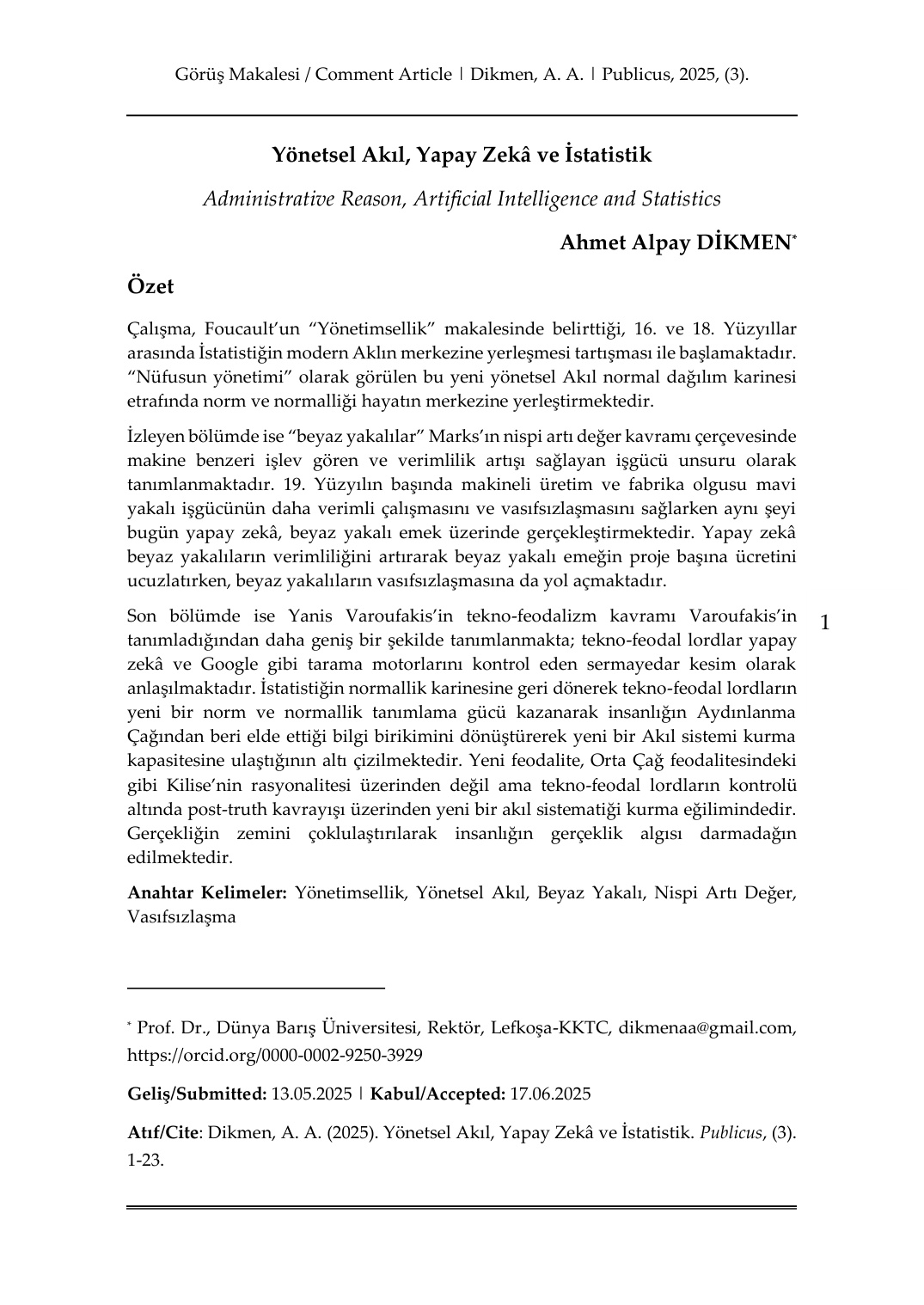
This study opens by tracing the historical emergence of statistics as a central apparatus of modern Reason, drawing upon Michel Foucault’s concept of governmentality. Foucault elucidates how, from the 16th to the 18th centuries, statistics evolved as a critical technology of governance—integral to the "government of populations"—through which the concepts of the norm and normality were institutionalized as key mechanisms for organizing social life, primarily via the logic of the normal distribution.
The second section reconceptualizes white-collar labour through the Marxian framework of relative surplus value, arguing that contemporary professional labour increasingly functions as a mechanized extension of capital accumulation. Analogous to the effects of industrial mechanization on blue-collar workers in the 19th century, artificial intelligence today augments white-collar productivity while simultaneously de-skilling the workforce and compressing compensation per task. In this sense, AI operates as a disciplinary force that restructures the labour process in alignment with capital’s imperatives.
The final section revisits and expands Yanis Varoufakis’s theorization of techno-feudalism, positing that the capitalist elites who command AI technologies and digital infrastructures—particularly search engines—constitute a new form of techno-feudal lords. Revisiting the statistical presumption of normality, the analysis contends that these actors now wield the epistemic authority to redefine norms, reorganize knowledge systems, and recalibrate the ontological coordinates of modernity. Much like the Church under medieval feudalism, which asserted theological monopoly over truth, techno-feudalism inaugurates a new epistemological order grounded in the logic of post-truth. Through the multiplication and relativization of truth claims, this emerging regime fragments collective understanding and undermines humanity’s shared capacity to apprehend, negotiate, and stabilize meaning.
Downloads
Published
Issue
Section
License
Copyright (c) 2025 Author(s)

This work is licensed under a Creative Commons Attribution-NonCommercial-NoDerivatives 4.0 International License.
No royalties are paid for the articles published in the journal. The copyright of the published articles remains with the author(s). Nevertheless, the journal promotes and supports universal open access to scientific content. In accordance with the Creative Commons Attribution-NonCommercial-NoDerivatives 4.0 (CC BY-NC-ND 4.0) License, the journal permits the copying, distribution, and reuse of published articles for non-commercial purposes, provided that proper scientific citation and attribution rules are followed.

