
Land Readjustment and Disaster Management Planning Integration: An Assessment on Public Resource Optimization
DOI:
https://doi.org/10.65911/pcqebj12Keywords:
Disaster Management, Land Regulation, Disaster Plans, Integrated Plan, Risk Reduction StrategiesAbstract
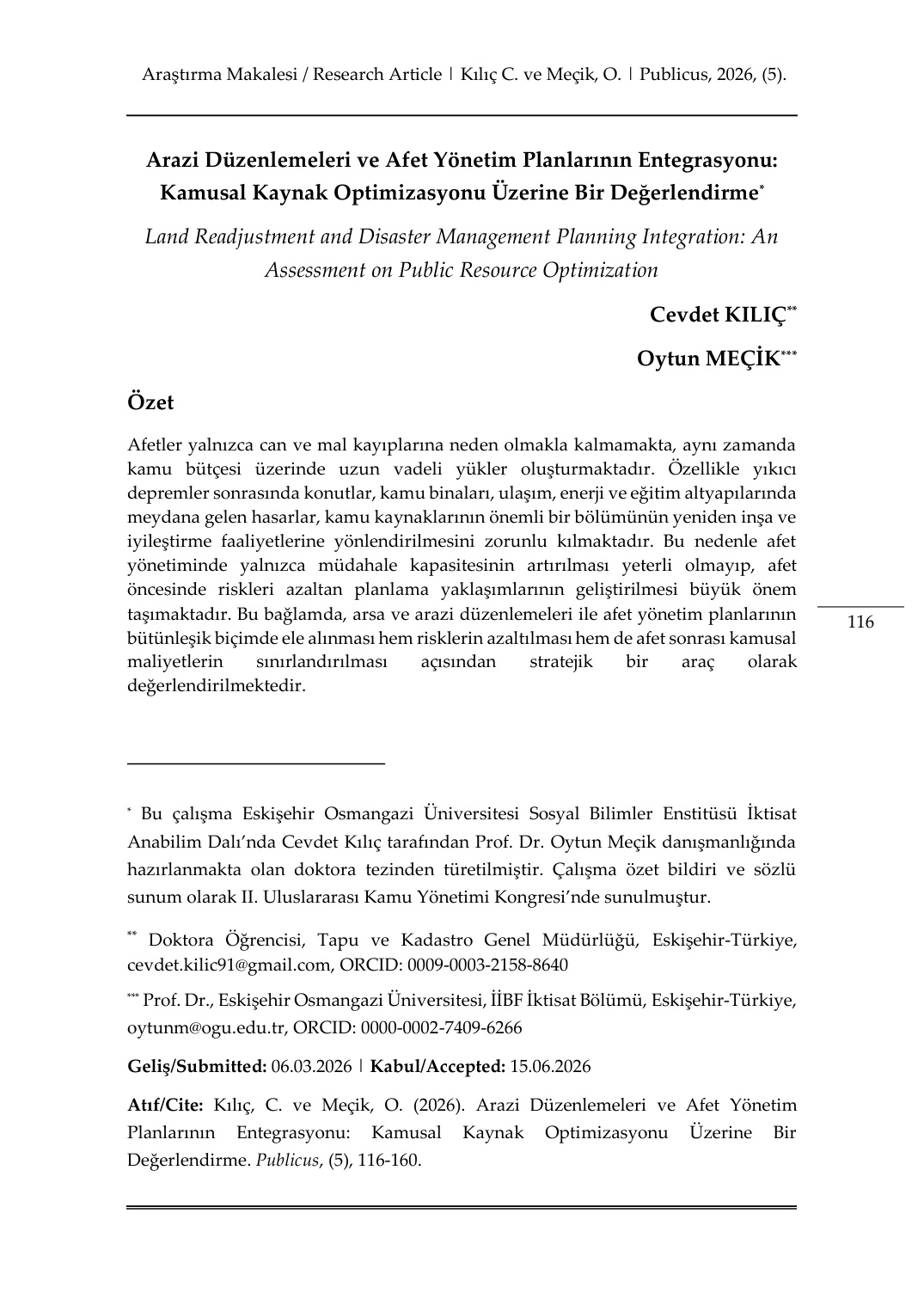
Disasters not only result in loss of life and property but also impose significant long-term burdens on public budgets. Particularly after devastating earthquakes, damage to housing, public buildings, transportation networks, energy systems, and educational infrastructure necessitates the allocation of substantial public resources for reconstruction and recovery efforts. Therefore, increasing response capacity alone is insufficient in disaster management; developing planning approaches that reduce risks before disasters occur is equally important. In this context, the integration of land readjustment practices with disaster management plans emerges as a strategic tool for both mitigating disaster risks and limiting post-disaster public expenditures.
This study examines how the integration of disaster management plans with land readjustment policies contributes to the efficient use of public resources. The research evaluates the effects of pre-disaster preventive measures on post-disaster public spending. It analyzes the role of land readjustment in risk reduction and resilience building by drawing on evidence from the 1994 Northridge Earthquake in the United States and the 1999 Chi-Chi Earthquake in Taiwan. In addition, the legal frameworks and planning systems of Türkiye and Japan are comparatively examined.
The study is based on a qualitative research design employing document analysis. Urban planning legislation, disaster management plans, national policy documents, and international disaster risk reduction frameworks were reviewed. The findings indicate that the strongest alignment with the Sendai Framework for Disaster Risk Reduction is provided by Zoning Law No. 3194 and Law No. 6306 on the Transformation of Areas Under Disaster Risk. In contrast, the Geographical Information Systems (GIS) Law No. 7221, the Turkish Disaster Risk Reduction Plan (TARAP), and the Turkish Post-Disaster Recovery Plan (TASİP) demonstrate a moderate level of alignment, while the Turkish Disaster Response Plan (TAMP) has a more limited relationship with land readjustment practices.
The study concludes that response-oriented approaches alone are insufficient for reducing disaster-related costs. Land readjustment policies integrated with disaster management plans and GIS-based integrated planning practices can make significant contributions to both the development of disaster-resilient settlements and the sustainable and efficient management of public resources.
References
Artantaş, E. ve Gürsoy, H. (2024). Şiddetli deprem ve ekonomik gelişmelere yönelik stratejiler ve Türkiye'nin deprem deneyimlerinden çıkarılacak sorunlar, Kahramanmaraş ve Gölcük depremleri örneği. Ömer Halisdemir Üniversitesi İktisadi ve İdari Bilimler Fakültesi Dergisi, 17(2), 192-214. https://doi.org/10.25287/ohuiibf.1331580
Aşikoğlu Şahin, G. (2009). Kentsel Afet Risklerine Yönelik Zarar Azaltma Stratejilerinin Geliştirilmesi [Yayımlanmamış doktora tezi]. Dokuz Eylül Üniversitesi Fen Bilimleri Enstitüsü. https://acikerisim.deu.edu.tr/handle/20.500.12397/9249, Erişim: 19.08.2025.
CBS. (2020, 20 Şubat). Coğrafi Bilgi Sistemleri ile bazı kanunlarda değişiklik yapılması hakkında kanun [Kanun No. 7221]. Resmî Gazete, 31045.
Çağdaş, V., ve Linke, H. J. (2019). Almanya’da Arazi Düzenlemesi. Jeodezi ve Jeoinformasyon Dergisi, 6(2), 96-114. https://dergipark.org.tr/en/download/article-file/846390, Erişim: 11.07.2025.
Elmacı, O. (2025). Türkiye’de Şirket Kapitalizmi: Kamusal Varlıkların Sermaye Birikim Rejimine Devri Üzerine Eleştirel Bir İnceleme. https://portal.dpu.edu.tr/orhan.elmaci/makale_oku/1096/turkiyede-sirket-kapitalizmi-kamusal-varliklarin-sermaye-birikim-rejimine-devri-uzerine-elestirel-bir-inceleme, Erişim: 26.08.2025
Ergünay, O. (2007). Türkiye’nin afet profili. TMMOB afet sempozyumu bildiriler kitabı, 5(7), 1-14. https://www.academia.edu/download/32659844/Turkiyenin_afet_profili.pdf, Erişim: 02.09.2025
Eyidoğan, H. (2018). Afet ve Acil Durum Yönetimi Örgütlenmesi ve Afet Risklerimizin Değerlendirilmesi. Sosyal Demokrat Dergi, (87-88). https://www.sosyaldemokratdergi.org/haluk-eyidogan-afet-ve-acil-durum-yonetimi-orgutlenmesi-ve-afet-risklerimizin-degerlendirilmesi, Erişim: 16.07.2025.
Galioğlu, Y., ve Özlüer, F. (2012). Afet Yönetimi ve Politik: Depremlerin Altında Kalmak. Ekososyalist Dergisi, (2). https://www.peyzajmimoda.org.tr/icerik/afet-yonetimi-ve-politik-depremlerin-altinda-kalmak-4228, Erişim: 06.06.2025
Göver, İ. H. Türkiye ve Japonya’nın Deprem Gerçekliği: Karşılaştırmalı Bir Analiz. Mevzu: Sosyal Bilimler Dergisi, 10, 278-323. https://doi.org/10.56720/mevzu.1319896
Gür Türkdoğan, T. (2024). Afet ve Risk Yönetiminde Blokzincir Teknolojisinin Uygulanabilirliği Üzerine Bir Değerlendirme. Atlas Journal, 10(53), 23-40.
Japanese Law Translation. (t.y.). Disaster Countermeasures Basic Act. https://www.japaneselawtranslation.go.jp/en/laws/view/4171#je_ch3at9, Erişim: 01.03.2026.
Kadıoğlu, M., ve Özdemir, E. (2008). Afet Zararlarını Azaltmanın Temel İlkeleri. JICA Türkiye Ofisi Yayın No: 2. İsmet Matbaacılık. https://www.researchgate.net/profile/Mikdat_Kadioglu/publication/258108841_AFET_ZARARLARINI_AZALTMANIN_TEMEL_ILKELERI/links/02e7e526fa88ae4623000000/AFET-ZARARLARINI-AZALTMANIN-TEMEL-ILKELERI.pdf, Erişim: 14.07.2025.
Küçükyağcı, T. (2024). Afetle mücadelede yerel yönetimlerin rolü ve etkisi: Japonya-Türkiye karşılaştırması. Nevşehir Hacı Bektaş Veli Üniversitesi SBE Dergisi, 14(Türkiye-Japonya İlişkileri 100. Yıl Özel Sayısı), 237-255. https://doi.org/10.30783/nevsosbilen.1523658,
Kılıç, C. ve Meçik, O. (2025)., II. Uluslararası Kamu Yönetimi Kongresi Bildiri Özetleri Kitabı. Kamu Yönetimi Derneği.
Mileti, D. S. (1999). Disasters by Design: A Reassessment of Natural Hazards in the United States. Joseph Henry Press. https://books.google.com/books?hl=tr&lr=&id=NQtSAgAAQBAJ, Erişim: 18.05.2025.
Niğde Ömer Halisdemir Afet Eğitim ve Yönetimi Uygulama ve Araştırma Merkezi (2023), Afet Eğitimi ve Yönetimi Uygulama ve Araştırma Merkezi, Depremlerin Büyüklüğü ve Şiddeti, En Son Güncelleme: 2023 https://www.ohu.edu.tr/ohuafet/sayfa/depremlerin-buyuklugu-ve-siddeti, Erişim Tarihi: 02.04.2026
OECD. (2021). Financial Management of Catastrophe Risks. OECD Publishing. https://www.oecd.org/content/dam/oecd/en/publications/reports/2021/11/financial-management-of-catastrophe-risks_413d99f6/92106475-en.pdf, Erişim: 04.05.2025.
Planlı Alanlar İmar Yönetmeliği, RG: 03.07.2017/30113. https://www.mevzuat.gov.tr/mevzuat?MevzuatNo=23722&MevzuatTur=7&MevzuatTertip=5
Sağlam, S. (2006). Türkiye’de İç Göç Olgusu ve Kentleşme. Hacettepe Üniversitesi Türkiyat Araştırmaları (HÜTAD) (5), 33-44. https://dergipark.org.tr/en/pub/turkiyat/issue/16667/330762, Erişim:17.07.2025
UNİSDR (2015), Sendai Afet Risk Azaltma Çerçevesi Belgesi, UCLG-MEWA, https://uclg-mewa.org/sendai-afet-risk-azaltma-cercevesi-2015-2030/, Erişim Tarihi: 01.04.2026
T.C. Strateji ve Bütçe Başkanlığı, (2023) 2023 Yılı Genel Faaliyet Raporu, Erişim Adresi: https://www.sbb.gov.tr/wp-content/uploads/2024/06/2023-Yili-Genel-Faaliyet-Raporu.pdf, Erişim:23.07.2025
Sayıştay. (2021). Afet ve Acil Durum Yönetimi Başkanlığı Denetim Raporu. T.C. Sayıştay Başkanlığı. https://www.sp.gov.tr/upload/xSPRapor/files/XOkYy%2BAFAD_21_FR.pdf, Erişim: 24.08.2025.
Tahtalı, M. B. (2012). Türk İmar Hukukunda Düzenleme Ortaklık Payı Uygulaması, Akdeniz Üniversitesi. http://acikerisim.akdeniz.edu.tr/handle/123456789/2263, Erişim: 12.08.2025.
TAMP. (2022). Türkiye Afet Müdahale Planı (TAMP). https://www.afad.gov.tr/turkiye-afet-mudahale-plani, Erişim: 15.09.2025.
TARP. (2022). Türkiye Afet Risk Azaltma Planı (TARAP). https://www.afad.gov.tr/turkiye-afet-risk-azaltma-plani-tarap, Erişim: 19.09.2025.
TASİP. (2025). Türkiye Afet Sonrası İyileştirme Planı (TASİP). https://afad.gov.tr/kurumlar/afad.gov.tr/e_Kutuphane/Planlar/TASIP/23052025-TASIP.pdf Erişim: 01.05.2026.
TBMM. (2023). Deprem Araştırma Komisyonu Raporu. Türkiye Büyük Millet Meclisi. https://downloads.ctfassets.net/dq9b2d58kdrp/1lsNnDpzg2mqZAmTMAnnUH/2ce5ba429dda2c2f2f3bcccea2e83292/Deprem_Ara_t_rma_Komisyon_Raporu_2023.pdf, Erişim: 23.09.2025.
Türk, Ş. Ş., ve Ünal, Y. (2003). Arazi ve Arsa Düzenlemesi Metoduna İlişkin Olumsuz Önyargı. İTÜ Dergisi/A, 2(1). http://itudergi.itu.edu.tr/index.php/itudergisi_a/article/view/1001, Erişim: 25.09.2025.
Türk Kızılay Derneği Tüzüğü, RG: 27.04.2022/31822. https://www.resmigazete.gov.tr/eskiler/2022/04/20220427-11.pdf
Trading Economics. (2025). Turkey Interest Rate. https://tr.tradingeconomics.com/turkey/interest-rate, Erişim: 27.09.2025.
UMKE. (2003). Ulusal Medikal Kurtarma Ekibi Birimi. https://ashgmafetacildb.saglik.gov.tr/TR-80255/ulusal-medikal-kurtarma-ekibi-birimi-umke.html, Erişim: 01.09.2025.
Yılmaz, C. (2024). Afet Sonrası Yeniden Yapılanmada İş Birliğine Dayalı Stratejik Mekânsal Plan Model Önerisi: Hatay Örneği [Doktora tezi]. Mimar Sinan Güzel Sanatlar Üniversitesi. https://acikerisim.msgsu.edu.tr/xmlui/handle/20.500.14124/6923, Erişim: 01.092025.
Wu, J. Y., ve Lindell, M. K. (2004). Housing Reconstruction After Two Major Earthquakes: The 1994 Northridge Earthquake in the United States and the 1999 Chi-Chi Earthquake in Taiwan. Disasters, 28(1), 63-81. https://onlinelibrary.wiley.com/doi/abs/10.1111/j.0361-3666.2004.00243.x, Erişim: 16.07.2025.
Yomralıoğlu, T. (2021). Arazi Yönetimi [Yayınlanmamış ders notları]. Geomatik Mühendisliği Bölümü, İstanbul Teknik Üniversitesi. https://www.tahsinhoca.net/yayinlar, Erişim: 14.07.2025.
Downloads
Published
Issue
Section
License
Copyright (c) 2026 The copyright of this paper belongs to the author.

This work is licensed under a Creative Commons Attribution-NonCommercial-NoDerivatives 4.0 International License.
No royalties are paid for the articles published in the journal. The copyright of the published articles remains with the author(s). Nevertheless, the journal promotes and supports universal open access to scientific content. In accordance with the Creative Commons Attribution-NonCommercial-NoDerivatives 4.0 (CC BY-NC-ND 4.0) License, the journal permits the copying, distribution, and reuse of published articles for non-commercial purposes, provided that proper scientific citation and attribution rules are followed.

