
Writing and Reference Rules
Click to download the template.
Manuscripts submitted to the Journal are required to include a cover page at the beginning. This cover page should feature the title of the paper, the full name(s) of the author(s), their academic title(s), affiliation(s), and, where applicable, their ORCIDs. Additionally, authors should provide their email addresses and phone numbers for communication purposes. In the publication, author information should include the names, academic titles, institutional affiliations, and ORCID numbers of the author(s). Authors may also opt to share their email addresses. Authors who choose to include such contact details are required to submit this information at the time of manuscript submission.
For research and review articles, authors are expected to include both Turkish and English abstracts, each consisting of a minimum of 250 and a maximum of 300 words and 5 keywords. For articles written in Turkish, a detailed English Extended Abstract at a minimum of 400 and a maximum of 500 words should be included at the end. The abstracts should be formatted in Palatino Linotype, 10-point font size, with no spacing between lines and a 6-point space between paragraphs. Turkish and English abstracts should be presented on separate pages following the cover page. It is important to note that Turkish and English abstracts are not obligatory for other types of articles.
The main body of the paper should commence on a separate page following the cover page and abstracts.
For research and review articles, the length should fall within the range of 6000 to 9000 words, inclusive of footnotes and references. Book reviews should be between 1500 and 3000 words. With the exception of editorial pieces, replies, corrigenda and addenda, and obituaries, other article types (such as comment articles, reports, roundtable discussions, interviews, and letters to the editor) should range from 3000 to 6000 words. The Editorial Board retains the right to adjust these word limits for any type of paper, as deemed necessary.
The main title of the paper should be bold and centered. Subheadings can be utilized at up to four levels, indicated in 12-point font.
Level 1 subheading: Aaaa Bbbb Cccc (left justified + initial letter of each word is bold and capitalized)
Level 2 subheading: Aaaa Bbbb Cccc (left justified + initial letter of each word is capital, bold, and italics)
Level 3 subheading: Aaaa bbbb cccc (initial letter of the first word is capitalized, the others are lowercase and italicized)
Level 4 subheading: i) Aaaa bbbb cccc (numbering (i, ii, iii, etc.) + initial letter of the first word is capitalized, while the others are lowercase and italics)
The text should be written in Palatino Linotype font and 12-point size. There should be 1.15 pt space between lines and 12 pt (6 pt before and 6 pt after) space between paragraphs. New paragraphs should not begin with a “first line indentation.”
Graphs, figures, tables, pictures, and photographs in the paper must be numbered along with their titles and placed appropriately on the relevant visual. Each should be numbered, as shown in Table 1, Figure 2. Numbers and names should be written in a 10-point font and bold. If the source of the image is to be included along with the name, it should be stated below the name as "Source: Alaska Permanent Fund Corporation (2024)." Appendices, if included, should be numbered and inserted after the References section. Appendices should be titled as Annex 1, Annex 2, and so forth. Tables should not be allowed to overflow onto the next page; if this is not possible, the table should be arranged so that the row and/or column headings appear on every page.
Figure 1. Sample of Table/Figure/Graph Numbering and Naming
Figure 2. Annual Change in the Value of the Alaska Permanent Fund (1980-2022)
Source: Alaska Permanent Fund Corporation (2024)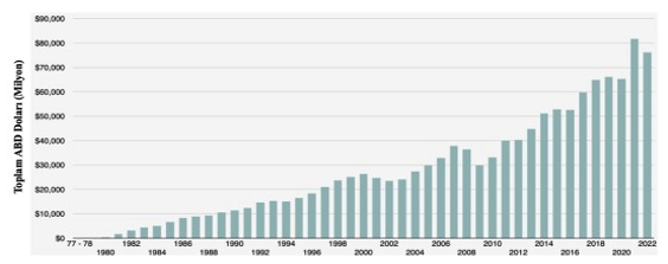
The reference list should be placed at the end of the paper, starting on a new page before the Appendices. The references should be formatted with a hanging paragraph style, with a hanging paragraph value of 1 cm. They should be arranged alphabetically by the surname of the corresponding author. References should be written in Palatino Linotype, 10-point font size, with a line spacing of 1.15, and a 12 pt space between paragraphs (6 pt before and 6 pt after).
CITATION AND REFERENCING RULES
Authors are required to adhere to the citation and referencing guidelines outlined below when preparing their manuscripts. Failure to comply with these rules may result in rejection of the manuscript. Alternatively, authors may be asked to revise their manuscripts, or the Editorial Board may make revisions according to the Journal's guidelines. The Editorial Board has final authority in this regard.
General Rules
Below are examples illustrating the rules of citation and referencing for various types of publications. Authors should adhere to the APA 7 guideline for cases not covered here. The Publication Manual of the American Psychological Association – The Official Guide to APA Style (7th Ed.) is available upon request from the Editorial Board.
- When citing sources with more than 3 authors, put et al., after the first author’s last name. It is appropriate to use abbreviations (for example, Author et al., 2023, p. 27). The last names of all authors should be listed in the references.
- The following phrases should be included in the related section: if the date of the cited work is unknown (n.d.), if the institution or the author is unknown (n.a), and if the publishing house is unknown (publishing house n.).
- When citing sources to indicate their contribution to the literature or to draw comparisons, but not to cite a main argument of the source, the expressions "see" and "cf." are used instead of direct citation.
- When using footnotes for explanatory purposes in the text, citations should be made according to the following procedure.
- Block quotations within the text (quotations exceeding three lines) should be formatted as justified to the right, indented 1 cm from the left margin, without quotation marks, and in Palatino Linotype, 11-point font size.
- When citing multiple works by the same author from different years within the text, the citation should be formatted in chronological order as (Last name, year, year, year).
- When preparing manuscripts, authors should adhere to the specific citation and referencing rules for the language of the manuscript. For instance, in Turkish manuscripts, the abbreviation for "page" is "s.", while in English manuscripts, it is "p.". Similarly, when citing an article from a compiled book, the Turkish term "içinde" should be used in the references for Turkish texts, whereas the English term "In" should be used for English texts. Additionally, in Turkish texts, the conjunction "ve" should be used for citing sources, while in English texts, the "&" sign should be used.
- If any citation software is used while preparing the manuscript, parts that do not comply with the rules of citation and referencing need to be revised.
- If the text was prepared using citation software, it is important to upload plain text.
- Original sources such as legislation, archival documents, and periodicals should be grouped under a separate heading in the references, preceding secondary sources. This rule does not apply to books, articles, or other types of sources.
- Any source that is not cited should not be included in the references.
- The names of the translators must be included in the translated texts in the references.
- If the texts in the references have multiple editions, the edited version of the cited source used should be stated.
- In resources with a DOI number or a fixed URL, including e-resources, this information should be specifically stated in the references.
- Authors should include the last access date of the sources they access from the internet in accordance with the examples below.
- If the author(s) cite their own works, they must use the term "Author" instead of the relevant source in the citation and bibliography in order to ensure the principle of blind review (If the manuscript is accepted, the bibliography will be corrected before typesetting).
CITATION EXAMPLES
Referencing a book:
|
Citation |
(Hobsbawm, 2011, p. 27) |
|
Reference |
Hobsbawm, E. (2011). Kısa 20. Yüzyıl 1914-1991: Aşırılıklar Çağı (Y. Alogan, Trans.). Dost. |
|
Citation |
(Miller and Fox, 2007, p. 27) |
|
Reference |
Miller, H. T., and Fox, C. J. (2007). Postmodern Public Administration. ME Sharpe. |
Referencing an e-book:
|
Citation |
(Updike, 1996, p.3) |
|
Reference |
Updike, J. (1996). Memories of the Ford Administration [e-book]. Penguin Random House. https://www.penguinrandomhouse.com/books/181904/memories-of-the-ford-administration-by-john-updike/ |
Referencing an editorial book:
|
Citation |
(Erder et al., 2003, p. 27) |
|
Reference |
Erder, N., Çilingiroğlu, A., Sönmez, A., and Torun, O. N. (2003). Planlı Kalkınma Serüveni: 1960’larda Türkiye’de Planlı Kalkınma Serüveni. İstanbul Bilgi Üniversitesi Yayınları. |
Referencing a chapter in an editorial book:
|
Citation |
(Valero- Garcés, 2023, p. 18) |
|
Reference |
Valero- Garcés, C. (2023). General Issues About Public Service Interpreting: Institutions, Codes, Norms, and Professionalisation. In L. Gavioli and C. Wadensjö (Ed.), The Routledge Handbook of Public Service Interpreting (pp. 17-31). Routledge. |
Referencing an article:
|
Citation |
(Gülmez, 1975, p. 72) |
|
Kaynakça |
Gülmez, M. (1975). Weber ve İdeal Tip Bürokrasi Anlayışı. Amme İdaresi Dergisi, 8(1). 47-73. |
Referencing to a thesis:
|
Citation |
(Üstüner, 1992, p. 72) |
|
Reference |
Üstüner, Y. (1992). In search of an identity: Considerations on the theory and the discipline of public administration [Kimlik arayışı: Bir disiplin olarak kamu yönetimi ve kuramı] [Unpublished PhD Dissertation]. Orta Doğu Teknik Üniversitesi. |
Referencing to an encyclopedia/dictionary entry:
|
Citation |
(Sosyoloji Sözlüğü, Fordizm, p. 245) |
|
Reference |
Marshall, G. (1999). Fordizm. Sosyoloji Sözlüğü, pp. 245-246. |
Referencing to Internet webpage:
When citing internet content that is designed to change over time and does not have an archived version of the page, it is necessary to include the 'access date' in the citation. However, for works that can change over time but have archived versions available, the majority of references to these sources do not require an 'access date', as the archived version of the page remains fixed and retrievable.
|
Citation |
(afad.gov.tr) |
|
Reference |
AFAD, Hakkımızda. https://www.afad.gov.tr/afad-hakkinda, Access: 19.05.2023
|
|
Citation |
(YSK, 2007) |
|
Reference |
YSK. (2007). Anayasa Değişikliği Halkoylaması Sonuç Tutanağı. http://www.ysk.gov.tr/doc/dosyalar/docs/2007Referandum/Sonuc/sonuc.pdf |
Referencing a newspaper article:
|
Citation |
(Cumhuriyet Gazetesi, 18 November 2021, p. 7) |
|
Reference |
Cumhuriyet Gazetesi. (2021, November 18). Resmi Gazete’de yayımlandı: Erdoğan’dan yeni atamalar, p. 13 |
|
Citation |
(cumhuriyet.com.tr, 18 November 2021) |
|
Reference |
Cumhuriyet Gazetesi. (2021, November 18). Resmi Gazete’de yayımlandı: Erdoğan’dan yeni atamalar. https://www.cumhuriyet.com.tr/turkiye/resmi-gazetede-yayimlandi-erdogandan-yeni-atamalar-1893628, Access: 19.05.2023 |
Referencing a newspaper column:
|
Citation |
(Kuruç, 2022) |
|
Reference |
Kuruç, B. (2022, January 24). 24 Ocak has kapitalizmdir. Cumhuriyet. https://www.cumhuriyet.com.tr/yazarlar/bilsay-kuruc/24-ocak-has-kapitalizmdir-1902329, Access: 19.05.2023 |
Referencing audio-visual communication sources:
|
Citation |
(Raadschelders, 2024) |
|
Reference |
Raadschelders, J. (2024). Yönetimin Geleceği ve Kamu Yönetimi Çalışmaları: Demokrasi için Hesap Verebilirlik [Webinar]. Kamu Yönetimi Derneği. https://www.youtube.com/watch?v=HVMwzMb0mnE, Access: 23.01.2024. |
Referencing a legislation:
|
Citation |
The Official Gazette imprint should be given in parentheses where the relevant regulation is mentioned in the texts. …. According to Law No. 5442 on Provincial Administration (OG: 10.06.1949/7236)
|
|
Reference
|
Provincial Administration Law, No: 5442, OG: 10.06.1949/7236, https://www.mevzuat.gov.tr/mevzuatmetin/1.3.5442.pdf |
Referencing to Minutes Journal:
To maintain consistency with the original titles of official publications, the original Turkish names should be retained.
|
Citation |
(GNAT TD, C: 9, Vol. 1, Sess. 2: p. 17) |
|
Reference |
TBMM Tutanak Dergisi (Journal of Proceedings of the Grand National Assembly of Turkey [GNAT TD]), Düstur (Code of Laws [C]): 9, Vol. 1, Sess. 2, 26.05.1950 |
|
Citation |
(GNAT ZC, Vol. 15, Sess. 133, pp. 12-16) |
|
Reference |
TBMM Zabıt Ceridesi [Journal of Proceedings of the Grand National Assembly of Turkey [GNAT ZC], Vol. 15, Sess. 133, 24.12.1921 |
Referencing an archival document:
When referring to archival documents, month names should be written clearly due to the differences between the Hijri, Rumi, and Gregorian calendars; the Gregorian calendar must be specified before the Hijri or Rumi calendar.
To maintain consistency with the original titles of official publications, the original Turkish names should be retained.
|
Citation |
(TV: 283, 13 Mart 1845 / 3 Rebiü’l-ahir 1261, p. 1) |
|
Reference |
Takvîm-i Vekayi (TV), 283, 13 March 1845 / 3 Rebiü’l-ahir 1261 |
|
Citation |
(BOA, HH.d., 24406, pp. 17-18) |
|
Reference |
T.C. Devlet Osmanlı Arşivi (BOA), Hatt-ı Hümâyûn (HH.d.), 24406, 23 Muharrem 1292 / 01 March 1875 |

